Brain–Computer Interface (BCI)
Where'd You Go BernadetteBrain–Computer Interface (BCI) is the technology Elgin Branch presents as a way to translate brain activity into computer action, first demonstrated in his account through experiments with rhesus monkeys and later embodied in Samantha 2. The story gives the idea both a technical history and a human promise: moving from implanted electrodes and a joystick-controlled ball to a forehead-worn device intended to help paralyzed veterans live more independently, then ending with the project’s cancellation inside Microsoft.
Definition and Early Experiments
At TED, Elgin locates his first encounter with the field in work he did twenty-five years earlier, testing code for a Duke research team. He summarizes the ambition as an effort “to merge mind and computer.” The early experiment used two rhesus monkeys seated before a screen, where joysticks moved an animated ball toward a basket and successful movements earned treats. In Elgin’s presentation, the arrangement makes the problem legible: the computer receives an action through an external control, while the research asks whether it can instead act on signals from the brain.
The researchers implanted two hundred electrodes in the monkeys’ motor cortexes. After the animals had learned to steer with the joysticks, the joysticks were disconnected. The monkeys briefly fiddled with them, then looked at the screen and thought about moving the balls. The electrodes transmitted brain signals to a computer programmed to interpret them, allowing the monkeys to move the balls by thought and receive their treats. Elgin says they mastered the new method in about fifteen seconds. The demonstration’s central contrast is between a familiar physical controller and an action performed without it; the monkeys’ goal stays the same, but the route from intention to movement changes.
From Samantha to Samantha 2
Elgin’s later work at Microsoft began with Samantha, a voice-activated personal robot. The TED demonstration gives this earlier project a distinct role in the development of BCI: Samantha could respond to spoken commands, but she remained a machine that had to move through the world to carry them out. Elgin asks the robot to bring him popcorn, and it glides to a microwave, retrieves a pre-popped bag, and hands it to him. When a guest tries the same request without saying “please,” Samantha does not move; Elgin explains that he added the requirement after his daughter accused him of being a bully. The robot eventually drops the popcorn while trying to hand it over, turning its physical machinery into part of the joke.
Samantha could perform five hundred commands, but Elgin says the project could have been expanded further only at the cost of dealing with thousands of moving parts. It lacked marketplace agility, was too expensive to scale, and was canceled. That limitation prompts the conceptual turn toward BCI: “the complicating factor in creating a personal robot is the robot itself. Maybe we could just lose the robot.” Rather than build a more capable moving machine, Elgin proposes a system that connects a person’s thoughts to a computer without requiring a robot intermediary.
His TED presentation stages that transition through successive images and objects. After an initial slide shows monkeys with wires emerging from their heads, Elgin invokes Moore’s law to imagine how the technology might change over twenty years: first a chip beneath the skin, then a football helmet fitted with electrodes and wires that could be put on without wiring anything into the brain. Finally, he holds up a small device resembling a Band-Aid and introduces Samantha 2. The sequence compresses the distance between invasive laboratory equipment and a wearable interface, while the live demonstration gives the promised change a visible form.
Demonstration and Intended Use
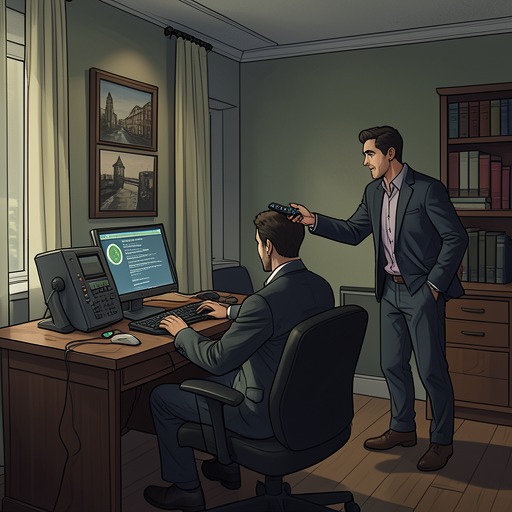
With the device attached to his forehead, Elgin demonstrates Samantha 2 by having it compose an email on its own. The screen opens Outlook; the recipient field fills with Bernadette’s name, and a message appears reporting on the TED talk, the broken clicker, and the Lakers score. The audience rises and roars as Elgin removes the device and holds it up. The demonstration presents BCI not simply as a means of controlling a ball or operating equipment, but as a link between a person’s brain and ordinary computer tasks.
Elgin says Samantha 2 is scheduled to ship to Walter Reed in March. He directs the audience to a Microsoft video showing paralyzed veterans using the system in a smart kitchen to cook, watch television, work on a computer, and care for a pet. He defines the project’s goal as helping wounded veterans lead independent and productive lives. These examples give the technology a practical standard of success: not novelty alone, but access to activities that support daily life. The scene’s emotional force comes from the contrast between Samantha’s cumbersome moving parts and Samantha 2’s small wearable form, as well as between a stage demonstration and the possibility of users performing tasks for themselves.
Cancellation and Significance
The project’s apparent triumph does not secure its continuation. Later, Elgin tells Bee Branch, “As of the tenth, Samantha 2 is canceled.” When Bee asks what cancellation means, he explains that the project is over and that the team is being folded into games. The abrupt ending reframes the TED applause: a compelling public demonstration and a stated aim of supporting independence do not, by themselves, ensure that an organization will keep developing the technology.
Across the account, BCI is defined through a chain of substitutions: the joystick gives way to thought-controlled movement; the robot gives way to a computer interface; implanted electrodes give way, in Elgin’s staged progression, to a helmet and then a small device worn on the forehead. Each step promises to reduce the physical machinery between intention and action. Yet the final cancellation shows that technical possibility and social use depend on institutional decisions as well as engineering. Samantha 2 is presented as a tool for autonomy, but its future remains subject to the priorities of the organization that built it.